
Japanese knotweed removal for homeowners, buyers and sellers
Finding Japanese knotweed at a home can be worrying, particularly when a sale, purchase or mortgage application is already under way. The good news is that it can be professionally managed. The important thing is to identify the plant correctly, understand how it affects the property and put the right paperwork and treatment in place.
For over 20 years, we have helped homeowners, buyers and sellers identify, manage and remove Japanese knotweed from gardens, driveways, boundaries and areas close to residential buildings.
We begin with a professional survey and give you a clear recommendation based on the infestation, your plans for the property and your timescale. Where treatment is required, we can provide a documented Japanese knotweed management plan and an insurance-backed guarantee, important reassurance for you and often for buyers, solicitors, surveyors and mortgage lenders too.
Call 023 8251 2752, email enquiries@knotweed-specialists.com or request a call back.

Get a free online assessment
Unsure if the growth in your garden is genuine Japanese knotweed? Avoid unnecessary worry or costly structural damage by leveraging our quick photo verification.
✓ Free professional identification within 24 hours.
✓ Fully confidential, expert regional analysis.
✓ Clear guidance on next steps if treatment is required.
RESIDENTIAL KNOTWEED ADVICE
Which situation best describes you?
Choose the route that fits your property journey. We’ll explain the survey, treatment and paperwork you may need.
I own a home with suspected knotweed
We can identify the plant, assess the affected area and explain your treatment options in plain English. You’ll receive a solution suited to your garden, access, future building plans and budget.
Book a residential surveyI am buying a property
A specialist Japanese knotweed house survey can give you and your solicitor a clearer picture before exchange. If knotweed is confirmed, we can prepare the report, treatment proposal and management documents you may need for your lender.
Explore buyers’ surveysI am selling a property
Acting early can help prevent knotweed becoming a last-minute obstacle. We can survey the property, document our findings and put the right management paperwork in place for your estate agent, conveyancer and buyer.
Prepare my property for saleOUR RESIDENTIAL PROCESS
What does residential Japanese knotweed removal involve?
Every property is different. Our survey-led process considers where the knotweed is growing, how you use the property and what you need to happen next.
Inspect the property
Identify and survey
A qualified surveyor confirms whether the plant is Japanese knotweed and records the visible location and extent of growth. We assess buildings, hard surfaces, boundaries, neighbouring land and any work you plan to carry out.
Make it clear
Explain the findings
We explain what has been found and what it means for your property. Where a formal report is needed, it can include photographs, a site plan, relevant risks and our recommended next step.
Match method to site
Choose the right treatment
Most residential properties are suited to one of two approaches. In some cases, combining them gives the best balance of cost, timescale and disruption.
Lower disruption and cost, with treatment and monitoring over several growing seasons.
Faster clearance for building work, landscaping or a time-sensitive property sale.
Create the record
Put the plan in writing
Where required, your Japanese Knotweed Management Plan records the affected area, chosen method, schedule, monitoring and responsibilities—creating clear evidence for you and anyone involved in a property transaction.
See it through
Treat, monitor and document
Our technicians carry out and record each visit. We continue monitoring in line with the plan, respond to regrowth and provide the relevant completion records when the plan requirements have been met.
PRICING
How much does residential Japanese knotweed removal cost?
Residential Japanese knotweed removal typically costs from £1,850, depending on the size and location of the infestation, site access, the treatment method and whether soil must be excavated or contained.
Most domestic jobs fall within these starting ranges:
| Method | Typical price | Outcome / timeline |
|---|---|---|
| 10 year herbicide knotweed management plan | From £1,850 | 10-year guarantee, controls regrowth |
| Full excavation | From £5,995 | Sifting/capping, prevents lateral spread |

Japanese knotweed house surveys
A general home survey or mortgage valuation is not designed specifically to identify Japanese knotweed. If you need clear evidence for a purchase, sale, lender or legal enquiry, arrange a specialist Japanese knotweed house survey.
Depending on your requirements, our survey can include:
- Inspection of accessible gardens, boundaries, hard surfaces and outbuildings
- Observations of visible growth on adjoining land
- Specialist identification, photographs and a site plan
- Assessment of the infestation and its effect on structures or use of the garden
- Treatment recommendations, a quotation and supporting documentation
Dense planting, recent cutting, seasonal growth or restricted access can limit what is visible. Any limitations will be clearly recorded in your report.
MOVING HOME
Buying or Selling a House with Japanese knotweed?
The right survey, paperwork and treatment plan can keep your property transaction moving.
For buyers
Buy with a clearer picture
Knotweed is not automatically a reason to walk away. Understand its actual impact before you exchange.
- Check the TA6 and records — including surveys, treatment plans and guarantees.
- Book a specialist house survey — a mortgage valuation is not a knotweed investigation.
- Speak to your lender early — requirements differ between mortgage providers.
- Review the plan before exchange — confirm costs, remaining work and whether the guarantee transfers.
Good to know: RICS guidance focuses on the plant’s actual effect on the property—not the old blanket 7-metre rule.
Buying a house with Japanese knotweedFor sellers
Prepare early and reassure buyers
Clear evidence from the start can prevent knotweed becoming a last-minute obstacle.
- Arrange a survey early — confirm the plant’s location, extent and recommended treatment.
- Do not cut or disturb it — this can hide useful evidence and spread viable fragments.
- Complete the TA6 carefully — answer accurately and follow your conveyancer’s advice.
- Prepare a buyer pack — include the survey, management plan, visit records and guarantee.
Good to know: A professional plan and insurance-backed guarantee can give buyers and lenders a documented route forward.
Selling a house with Japanese knotweedMortgages and Japanese knotweed management plans
Many lenders will consider a home affected by Japanese knotweed, but their requirements vary. Under the RICS residential framework, cases involving visible material damage or a significant restriction on the use of amenity space are the ones most likely to trigger a request for specialist action. This may include a Japanese knotweed management plan and an insurance-backed guarantee.
A robust plan should normally record:
- The property and the visible infestation;
- An accurate plan and supporting photographs;
- The treatment or removal method;
- The proposed schedule and a record of visits;
- Monitoring and completion requirements;
- What happens if regrowth occurs; and the terms of any contractor guarantee and third-party insurance.
No contractor can approve a mortgage. Send the documents to your mortgage broker, lender and conveyancer as early as possible and ask them to confirm what they require for the particular application.

Insurance and guarantees: what is the difference?
An insurance-backed guarantee supports the contractor’s guarantee if the contractor can no longer meet its obligations, subject to the policy terms. It is commonly requested alongside a professional management plan in residential transactions.
This is different from buildings insurance. Standard home insurance does not necessarily pay for Japanese knotweed treatment, removal or loss in value. Cover varies between insurers, so homeowners, buyers and sellers should check the policy wording and speak to the insurer or broker rather than assume a claim will be covered.
We explain the documents available with our plan, what they cover, how long they last and any conditions that apply. Find out more about our insurance-backed guarantee.
KNOW YOUR RESPONSIBILITIES
Japanese knotweed law for homeowners in England and Wales
On your propertyIt is not illegal simply to have knotweed
But you are responsible for controlling the risk. You must prevent it spreading beyond your land and deal with any removal or disposal correctly.
Prevent spread to neighbours
Allowing knotweed to encroach onto neighbouring land can result in a civil nuisance claim.
Do not spread it into the wild
Under the Wildlife and Countryside Act 1981, it is an offence to plant Japanese knotweed or otherwise cause it to grow in the wild.
Use the correct disposal route
Knotweed material and contaminated soil taken off site may be controlled waste. Use a registered waste carrier and an authorised facility.
Answer the TA6 accurately
Sellers are asked about knotweed on the TA6 Property Information Form. Take advice from your conveyancer if you are unsure.
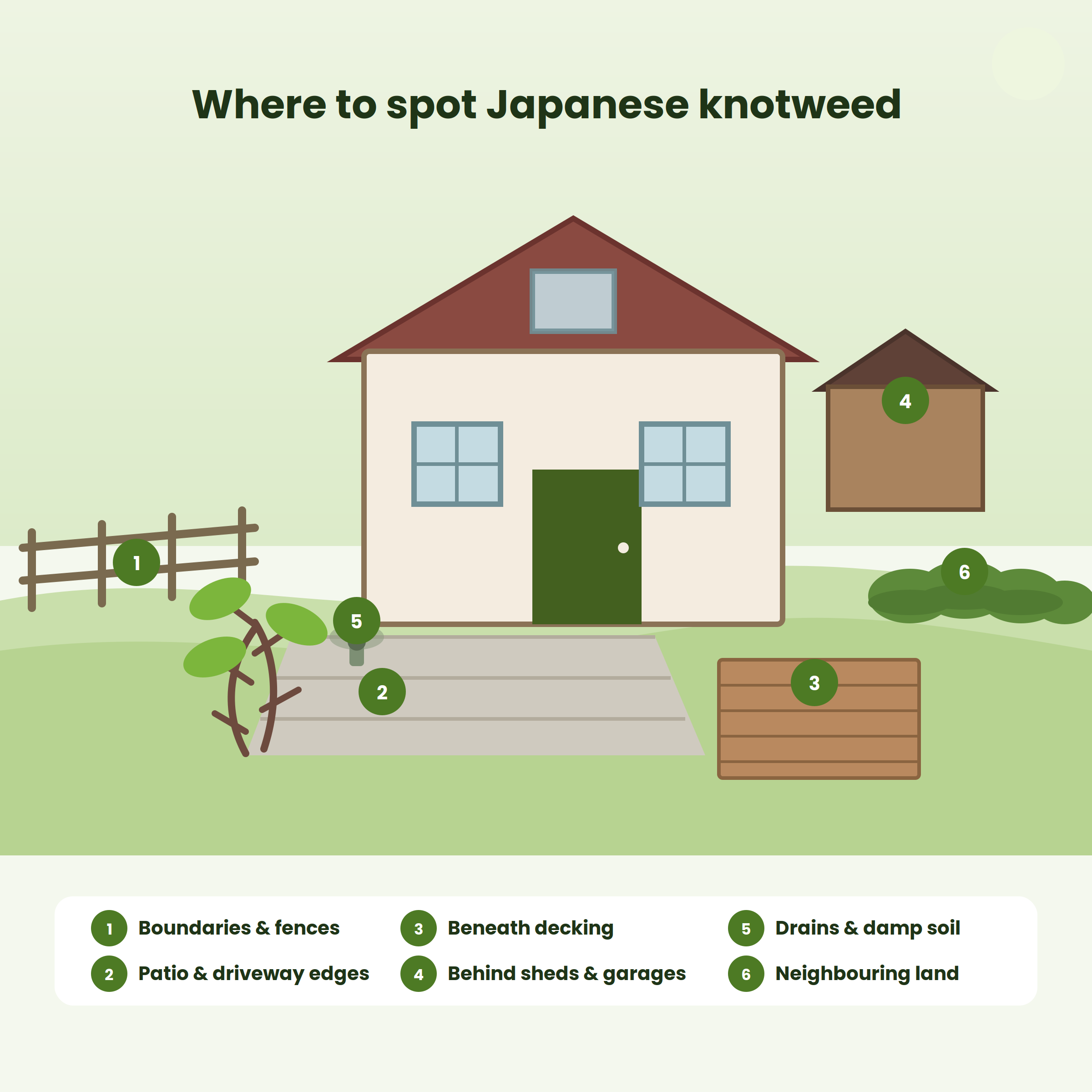
Where to look for Japanese knotweed at a residential property
Japanese knotweed often establishes where soil has been moved or along routes that make spread easier. Look carefully:
- Along fences, hedges and shared boundaries;
- Behind sheds, garages and other outbuildings;
- Beside patios, paths, driveways and retaining walls;
- Around drains, ditches, streams and damp ground;
- In recently disturbed or imported soil;
- On banks, overgrown corners and former dumping areas; and
- On adjoining land that is visible from the property.
Several common plants are mistaken for knotweed, and recent cutting or herbicide use can make it harder to identify. Use our visual guide as a prompt, not proof, and arrange a professional survey if a property decision depends on the answer.
COVERAGE
Areas we cover
- Sussex
- Hampshire
- Dorset
- Berkshire
- Wiltshire
- Bristol
- Gloucestershire
- Somerset
- South Wales
- London
FAQs
Can you remove Japanese knotweed yourself?
While it may be tempting to try to remove Japanese knotweed yourself, it is highly recommended that you use a residential Japanese knotweed removal specialist instead.
Japanese knotweed is a highly invasive plant that can quickly spread and cause damage to property and infrastructure. Removing Japanese knotweed requires specialised knowledge, equipment, and techniques to ensure that it is fully eradicated.
Hiring a Japanese knotweed removal specialist will ensure that the management of the knotweed is done safely and effectively, and will greatly reduce the risk of the plant regrowing or spreading.
Is it hard to sell a house with Japanese knotweed?
Having Japanese knotweed on a property can make it more difficult to sell, as many potential buyers may be deterred by the invasive, non-native plant’s reputation for causing damage to property and infrastructure.
However, it is possible to sell a house with Japanese knotweed, provided that the plant is properly managed and controlled. It’s important to disclose the presence of Japanese knotweed to potential buyers and provide evidence that it is being professionally treated and monitored.
Hiring a Japanese knotweed removal specialist to develop a management plan and provide ongoing maintenance can help to mitigate the negative impact of the plant on the property’s value and marketability.
Does Japanese knotweed reduce the value of a house?
Japanese knotweed can reduce the value of a house due to its reputation for causing damage to property and infrastructure. The presence of the plant can also make it more difficult to sell the house, as many potential buyers may be deterred.
However, the extent to which Japanese knotweed affects the value of a house can depend on factors such as the location and severity of the infestation, as well as the measures taken to manage and control it. Properly managing and treating Japanese knotweed with the help of a specialist can help to mitigate its impact on the property’s value and marketability.
Do you need planning permission to remove Japanese knotweed?
No, you do not need planning permission to remove Japanese knotweed from your property. In fact, it is recommended that you take action to remove the plant as soon as possible to prevent it from spreading and causing damage.
If you live in a conservation area or your property is listed, you may need to obtain permission from your local council before carrying out any removal work. It’s important to consult with a Japanese knotweed removal specialist who can provide guidance on the appropriate measures to take and any necessary permissions that may be required.
Do I have to declare knotweed?
Yes, you are legally obligated to declare its presence when selling your house with Japanese knotweed or leasing it. The Law Society’s TA6 form, which is part of the conveyancing process in England and Wales, requires sellers to disclose any knowledge of the presence of Japanese knotweed on the property.
Failure to disclose this information can result in legal action and financial penalties. It’s important to be transparent about the presence of Japanese Knotweed and to provide evidence that it is being professionally managed and treated.
Should I be worried if my neighbour has Japanese knotweed?
If your neighbour has Japanese knotweed, it’s important to be aware of the potential risks and take appropriate measures to protect your own property. Japanese knotweed is highly invasive and can spread quickly, so it’s important to monitor your property for any signs of infestation.
You may also want to consider discussing the issue with your neighbour and encouraging them to take action to manage and control the plant. If you’re concerned about the potential impact on your property, you can consult with a Japanese knotweed removal specialist who can assess the situation and provide advice on the best course of action.